The Influence of Audio-Visual Media on Chest Pass Ability on Basketball Learning of Senior High School Grade X Students
DOI:
https://doi.org/10.33394/gjpok.v13i2.21379Keywords:
audiovisual instruction, basketball, chest pass, motor skill assessment, physical educationAbstract
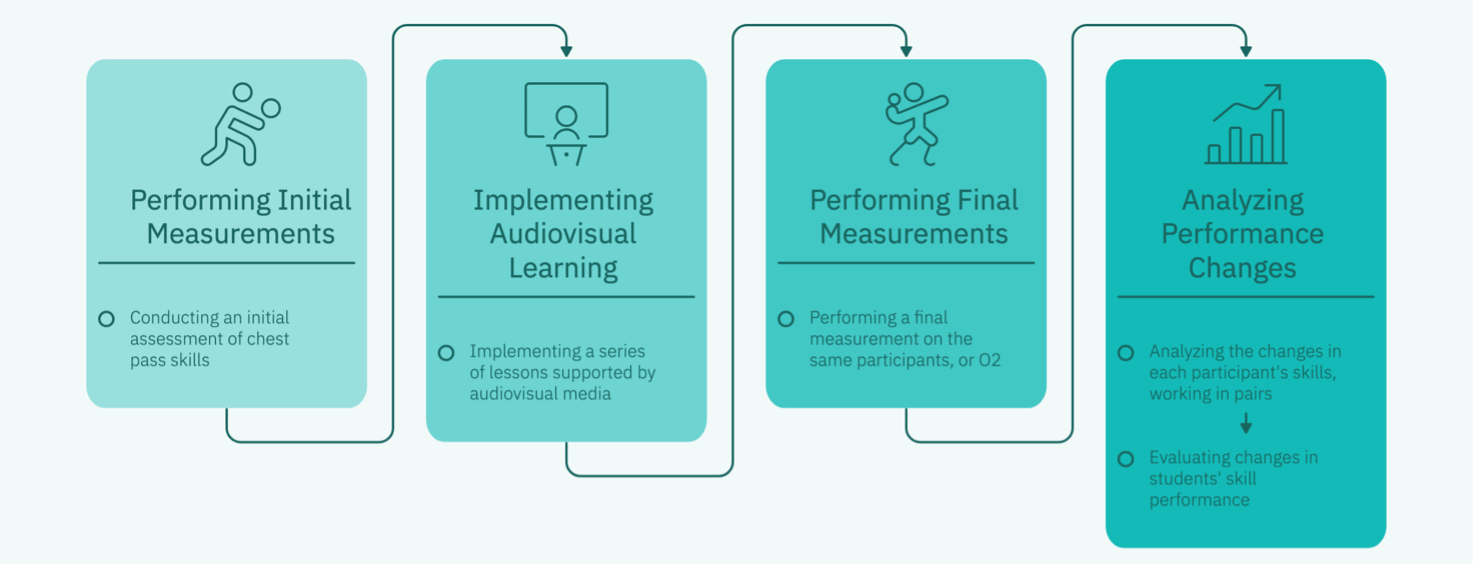
Audiovisual demonstrations may support motor-skill instruction, but evidence specific to chest-pass technique in regular senior high school physical education remains context-dependent. This study examined changes in chest-pass performance following audiovisual-assisted basketball instruction among Grade X students. A quantitative pre-experimental one-group pretest–posttest design was employed with 35 students from class X-2 at SMAN 1 Cibitung, selected through purposive sampling. Students completed a performance-based chest-pass assessment before and after instruction, covering initial stance, movement execution, and follow-through; component scores were combined into a total score. Descriptive statistics and the two-sided Wilcoxon signed-rank test were used to compare paired measurements, and rank-biserial correlation was reported as an effect-size indicator. The mean total score increased from 7.371 (SD = 1.864) at pretest to 9.171 (SD = 1.581) at posttest, representing a mean difference of 1.800 points. The paired comparison indicated a statistically significant difference (W = 5, z = −4.843, p < .001), with a rank-biserial correlation of −0.981 when differences were defined as pretest minus posttest. Improvements were also observed descriptively in all three movement components. These findings document positive changes in assessed chest-pass technique during the instructional period and suggest that audiovisual demonstrations may be a useful teaching resource alongside guided practice. However, the absence of a control group prevents attributing the changes specifically to audiovisual media, and the assessment does not establish passing accuracy, skill retention, or transfer to gameplay.
References
Al-Sinani, Y., & Al Taher, M. (2023). Enhancing teaching skills of physical education teachers in the Sultanate of Oman through augmented reality strategies: A comprehensive feedback-based analysis. Cogent Social Sciences, 9(2), 2266253. https://doi.org/10.1080/23311886.2023.2266253
Ashraf, R., Abdoli, B., Khosrowabadi, R., Farsi, A., & Pineda, J. A. (2023). The effect of modeling methods on mirror neuron activity and a motor skill acquisition and retention. Basic and Clinical Neuroscience, 14(5), 631–645. https://doi.org/10.32598/bcn.2021.3245.1
Aydogan, A., & Demirok, M. S. (2023). The effectiveness of computer aided video modeling in teaching basic basketball movements to individuals with Down syndrome. Children, 10(1), 153. https://doi.org/10.3390/children10010153
Bazzini, M. C., Nuara, A., Scalona, E., De Marco, D., Rizzolatti, G., Avanzini, P., & Fabbri-Destro, M. (2022). The proactive synergy between action observation and execution in the acquisition of new motor skills. Frontiers in Human Neuroscience, 16, 793849. https://doi.org/10.3389/fnhum.2022.793849
Bouzid, M. S., Melki, H., Romdhan, M. B., Hammoudi, S., Khalfallah, W., Rezgani, Y., Racil, G., & Padulo, J. (2025). The impact of video feedback on motor skill and motivation in acrobatic gymnastics through the use of digital tools in physical education. Journal of Human Sport and Exercise, 20(4), 1277–1292. https://doi.org/10.55860/pbyv8s24
Conte, D., Miani, J., & Pinzini, C. (2023). The effects of action observation in the lower limb landing biomechanics: A systematic review and meta-analysis. Advances in Rehabilitation, 37(2), 9–20. https://doi.org/10.5114/areh.2023.127924
Diekhoff, H. (2024). 'I can show you; here's the video'–video-supported student-led debates in game-based approaches. Cogent Education, 11(1), 2398842. https://doi.org/10.1080/2331186X.2024.2398842
Fauzi, R. A., Suherman, A., Saptani, E., Tingsabhat, S., & Heryanto, M. (2026). The effect of digital video feedback on roundoff learning outcomes in gymnastics learning. Frontiers in Sports and Active Living, 8, 1771596. https://doi.org/10.3389/fspor.2026.1771596
Fazeli, D., Jabbari, F., Ghohestani, L., & Taghizadeh, H. (2025). Manipulation of information type and task constraints during observational learning improve coordination but not accuracy and control parameters. PLOS ONE, 20(10), e0317270. https://doi.org/10.1371/journal.pone.0317270
Feng, D., Cossich, V. R. A., Abdelrasoul, E., Campelo, A. M., & Katz, L. (2025). The impact of video performance technology and peer-to-peer learning on table tennis skill acquisition in elementary students. Frontiers in Sports and Active Living, 7, 1653334. https://doi.org/10.3389/fspor.2025.1653334
Geisen, M., Baumgartner, T., Riedl, N., & Klatt, S. (2026). Real-time feedback in video-based motor learning: A pilot study exploring innovative training methods. Research and Practice in Technology Enhanced Learning, 21, 21038. https://doi.org/10.58459/rptel.2026.21038
Ghorbel, A., Yaakoubi, M., Alsaeed, M. I., Said, N. B., Masmoudi, L., Scharenberg, S., Gharbi, A., & Trabelsi, O. (2026). A quasi-experimental study of the video-based "Did You Know?" blended learning model in physical education: Impact on motor skills, knowledge acquisition, and motivation in gymnastics. Frontiers in Psychology, 17, 1695403. https://doi.org/10.3389/fpsyg.2026.1695403
Girard, A., & Vors, O. (2021). Knowledge mobilized in teacher–student interactions in PE in difficult vocational high school classes: Enacted knowledge. Frontiers in Psychology, 12, 664677. https://doi.org/10.3389/fpsyg.2021.664677
Greve, S., Diekhoff, H., & Süßenbach, J. (2022). Learning soccer in elementary school: Using teaching games for understanding and digital media. Frontiers in Education, 7, 862798. https://doi.org/10.3389/feduc.2022.862798
Han, Y., Syed Ali, S. K. B., & Ji, L. (2022). Use of observational learning to promote motor skill learning in physical education: A systematic review. International Journal of Environmental Research and Public Health, 19(16), 10109. https://doi.org/10.3390/ijerph191610109
Hasyim, A. H., Prabowo, E., Juniarto, M., Suparman, S., & Haris, I. N. (2025). Model pembelajaran passing chest pass bola basket berbasis permainan. Biormatika: Jurnal Ilmiah Fakultas Keguruan dan Ilmu Pendidikan, 11(1), 15–21. https://doi.org/10.35569/biormatika.v11i1.2215
Hiromitsu, Y., & Ishikura, T. (2021). Effects of learners' choice of video self-modeling on performance accuracy and perceived cognitive consistency. Journal of Physical Education and Sport, 21(3), 1284–1293. https://doi.org/10.7752/jpes.2021.03163
Kachouri, E., Ezeddine, G., Kachouri, H., Clark, C. C. T., Mkaouer, B., & Souissi, N. (2026). The acute effect of expert video modelling on tennis serve performance in 7- to 9-year-old players. Acta of Bioengineering and Biomechanics, 28(3), 43–53. https://doi.org/10.37190/abb/230881
Kempa, R., Sahalessy, A., Souisa, M., & Apituley, V. H. R. (2025). Barriers to ICT integration in elementary physical education: Evidence from Tual City, Maluku Province. Online Learning in Educational Research, 5(1), 217–229. https://doi.org/10.58524/oler.v5i1.685
Lagarrigue, Y., Cappe, C., & Tallet, J. (2021). Regular rhythmic and audio-visual stimulations enhance procedural learning of a perceptual-motor sequence in healthy adults: A pilot study. PLOS ONE, 16(11), e0259081. https://doi.org/10.1371/journal.pone.0259081
Li, Z., & Liu, X. (2026). Effects of blended learning on physical fitness and basketball skills of male college students: A cluster randomized controlled trial. Frontiers in Psychology, 17, 1792646. https://doi.org/10.3389/fpsyg.2026.1792646
Minkels, C., van der Kamp, J., de Vries, R., & Beek, P. J. (2025). Learning how to swim in 5- to 12-year-old children: A scoping review of evidence-based motor learning methods. Frontiers in Sports and Active Living, 7, 1505301. https://doi.org/10.3389/fspor.2025.1505301
Nahardiya, G., Markus, A., Bennet, R., & Shamay-Tsoory, S. G. (2022). The benefits of learning movement sequences in social interactions. Frontiers in Psychology, 13, 901900. https://doi.org/10.3389/fpsyg.2022.901900
Namli, S., Özdemir, K., Sen, I., & Bedir, D. (2025). Virtual reality-supported video modeling for enhancing motor skill acquisition in swimming. BMC Sports Science, Medicine and Rehabilitation, 17(1), 182. https://doi.org/10.1186/s13102-025-01241-z
Ramezanzade, H., Badicu, G., Cataldi, S., Parimi, F., Mohammadzadeh, S., Mohamadtaghi, M., Zamani Sani, S. H., & Greco, G. (2023). Sonification of motor imagery in the basketball jump shot: Effect on muscle activity amplitude. Applied Sciences, 13(3), 1495. https://doi.org/10.3390/app13031495
Rekik, G., Belkhir, Y., Mezghanni, N., Jarraya, M., Chen, Y.-S., & Kuo, C.-D. (2021). Learning basketball tactical actions from video modeling and static pictures: When gender matters. Children, 8(11), 1060. https://doi.org/10.3390/children8111060
Rekik, G., Jouira, G., Belkhir, Y., Jarraya, M., Kuo, C.-D., & Chen, Y.-S. (2023). The effect of dynamic versus static visualizations on acquisition of basketball game actions: A diurnal study. Scientific Reports, 13(1), 18077. https://doi.org/10.1038/s41598-023-45278-x
Rezaei, M., Hatami, F., & Lotfi, G. (2023). The impact of different attentional focus strategies during modeling on the acquisition and retention of free throws in basketball. International Journal of Sport Studies for Health, 6(1), e135272. https://doi.org/10.61838/kman.intjssh.6.1.6
Safari, I., Supriyadi, T., & Susilawati, D. (2025). Holistic pedagogical model for table tennis: Integrating regulations, multimedia, and sportsmanship. International Journal of Human Movement and Sports Sciences, 13(3), 636–646. https://doi.org/10.13189/saj.2025.130318
Safitri, D. A., Ma'mun, S., & Sumarsono, R. N. (2022). Pengaruh media audio visual terhadap kemampuan passing chest pass dalam ekstrakulikuler bola basket SMP Negeri 1 Lemahabang. JIIP: Jurnal Ilmiah Ilmu Pendidikan, 5(12), 5325–5329. https://doi.org/10.54371/jiip.v5i12.1195
San, N. C., Lee, H. S., Bucholtz, V., Fung, T., Rafiei Milajerdi, H., & Katz, L. (2022). Nature and quality of interactions between elementary school children using video-modeling and peer-to-peer evaluation with and without structured video feedback. Frontiers in Education, 7, 856918. https://doi.org/10.3389/feduc.2022.856918
Sasaki, R., Niijima, A., Park, C., & Ogawa, T. (2026). Congruent sonification during practice impairs cue-reduced recall in a virtual reality rhythm-game task. Frontiers in Psychology, 17, 1–11. https://doi.org/10.3389/fpsyg.2026.1813641
Schussler, E., Jagacinski, R. J., Chaudhari, A., Buford, J. A., & Onate, J. A. (2024). Models of video feedback for youth athletes performing an American football tackle. Journal of Athletic Training, 59(3), 281–288. https://doi.org/10.4085/1062-6050-0602.22
Sha, L., & Chiu, W. H. (2025). Effect of guided dual-sensory information on motor learning outcomes based on spatiotemporal dimensions. PLOS ONE, 20(11), e0337236. https://doi.org/10.1371/journal.pone.0337236
Šitić, K., Bavčević, D., & Bavčević, T. (2025). Implementing a new method for teaching freestyle and back-stroke technique in high education PE—a comparative study. Journal of Kinesiology and Exercise Sciences, 13(23), 38–46. https://doi.org/10.5604/01.3001.0055.2686
Soederajat, S., Mahardhika, D. B., & Aminudin, R. (2022). The effect of drill training methods on the basic skills of basketball chest pass for extracurricular students at SMA Negeri 1 Sukatani. Jurnal Speed (Sport, Physical Education, Empowerment), 5(2), 153–159. https://doi.org/10.35706/jurnalspeed.v5i2.7116
Sönmez, H. G., Ergin, M., Koçak, Ç. V., Bozdağ, B., Kılınç, Ö., Turan, E., Canlı, U., & Aldhahi, M. I. (2026). The effect of video modeling on gymnastics-based motor skills in children with autism spectrum disorder. Healthcare, 14(8), 1009. https://doi.org/10.3390/healthcare14081009
Sorgente, V., Cohen, E. J., Bravi, R., & Minciacchi, D. (2022). The best of two different visual instructions in improving precision ball-throwing and standing long jump performances in primary school children. Journal of Functional Morphology and Kinesiology, 7(1), 8. https://doi.org/10.3390/jfmk7010008
Souissi, M. A., Ammar, A., Trabelsi, O., Glenn, J. M., Boukhris, O., Trabelsi, K., Bouaziz, B., Zmijewski, P., Souissi, H., Chikha, A. B., Driss, T., Chtourou, H., Hoekelmann, A., & Souissi, N. (2021). Distance motor learning during the COVID-19 induced confinement: Video feedback with a pedagogical activity improves the snatch technique in young athletes. International Journal of Environmental Research and Public Health, 18(6), 3069. https://doi.org/10.3390/ijerph18063069
Tannoubi, A., Ouergui, I., Srem-Sai, M., Hagan, J. E., Quansah, F., & Azaiez, F. (2023). Effectiveness of video modeling in improving technical skills in young novice basketball players: A quasi-experimental study. Children, 10(4), 687. https://doi.org/10.3390/children10040687
Tannoubi, A., Ahmed, N., Hagan, J. E., Srem-Sai, M., Geantă, V. A., & Azaiez, F. (2026). Effects of pre-session video observational modeling on emotional intelligence and 9 m shooting performance in U14 male handball players: A randomized controlled trial. Children, 13(5), 655. https://doi.org/10.3390/children13050655
Topalska, R., & Rumenov, Y. (2025). Facilitating the visualisation of moving games by implementing augmented reality in primary physical education classes. TEM Journal, 14(1), 816–822. https://doi.org/10.18421/TEM141-72
Wang, Z., Li, H., Wang, Q., Gao, Z., & Niu, J. (2026). The impact of self-modeling on athletic performance and self-efficacy: A systematic review and meta-analysis. Frontiers in Sports and Active Living, 8, 1809566. https://doi.org/10.3389/fspor.2026.1809566
Yang, S., He, S., & Shi, B. (2026). fNIRS cortical activation in Tai Chi observational learning. Frontiers in Psychology, 17, 1710673. https://doi.org/10.3389/fpsyg.2026.1710673
Zhang, X. (2025). The effectiveness of self-controlled video feedback in improving the teaching of track and field sports in physical education teachers from Chinese universities. International Journal of Education and Practice, 13(2), 753–771. https://doi.org/10.18488/61.v13i2.4131
Downloads
Published
How to Cite
Issue
Section
Citation Check
License
Copyright (c) 2026 Restu Andhika Firdaus, Rahmat Iqbal, Dhika Bayu Mahardika

This work is licensed under a Creative Commons Attribution-NonCommercial-ShareAlike 4.0 International License.