Content Analysis of the Match Performance of the Men's Ju-Jitsu Fighting System -77 kg Champion at the XXI National Sports Week (PON XXI) 2024
DOI:
https://doi.org/10.33394/gjpok.v13i2.21194Abstract
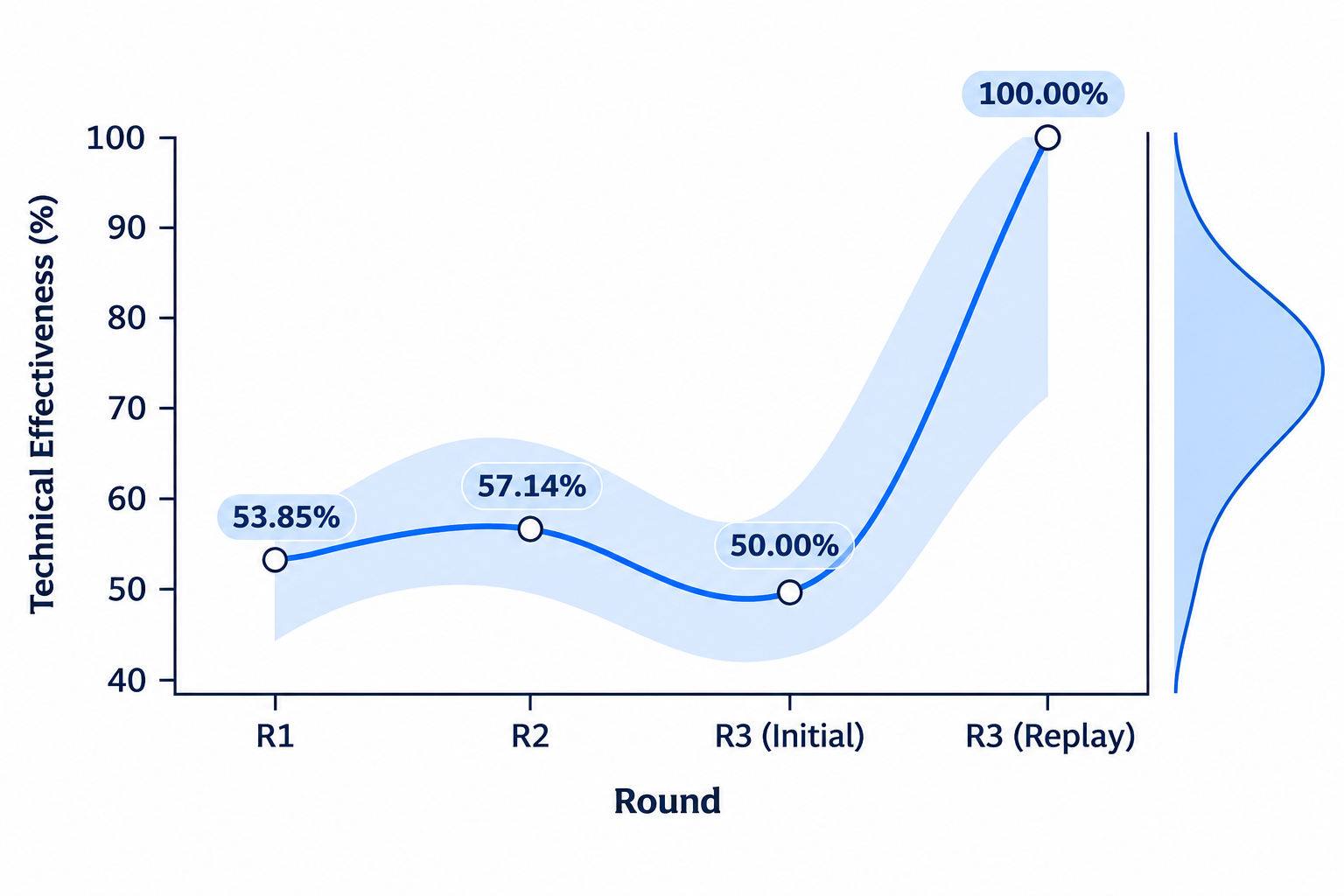
This study aimed to analyze the technical effectiveness and transition patterns employed by a gold medalist jiu-jitsu athlete in the Men's Fighting System −77 kg category at the 2024 National Sports Week (PON XXI) held in Aceh–North Sumatra. The central premise was that competitive performance depends not merely on the frequency of technical execution but also on execution effectiveness and the integration of technical actions across fighting phases. A quantitative descriptive approach was adopted using systematic observation of official match video recordings. The subject was Artz Brilliant, an athlete representing East Java who won the gold medal in this category. Four competition sequences were analyzed, comprising Round 1, Round 2, the initial Round 3, and the Round 3 replay. A total of 31 technical attempts were recorded across punches, kicks, throws, and submissions. The analysis identified 18 successful and 13 unsuccessful attempts, yielding an overall technical effectiveness of 58.06%. Kicks were the most frequently performed techniques, while throwing techniques demonstrated varying effectiveness across competition sequences. These findings support the central premise that higher technical frequency does not necessarily correspond to greater execution effectiveness. The comparison between the initial Round 3 and its replay revealed differences in technical performance, indicating that execution outcomes may vary across competitive situations, even against the same opponent. The observation framework also identified potential transitions between striking and grappling phases, although their precise frequencies and effectiveness require further verification through event-level analysis. Overall, the findings suggest that technical effectiveness and contextual performance variation are important dimensions of competitive jiu-jitsu performance. The study provides preliminary empirical evidence for developing evidence-based coaching strategies, systematic performance evaluation, and integrated technical–tactical training programs, while emphasizing the need for further research involving multiple athletes and validated observational procedures.
Keywords: Content Analysis, Technical Effectiveness, Transition Patterns, Video Analysis, Jiu-Jitsu
References
Akbaş, A., Marszałek, W., Drozd, S., Czarny, W., Król, P., Warchoł, K., Słomka, K. J., & Rzepko, M. (2022). The effect of expertise on postural control in elite sport ju-jitsu athletes. BMC Sports Science, Medicine and Rehabilitation, 14(1). https://doi.org/10.1186/s13102-022-00477-3
Ambroży, T., Rydzik, Ł., Kasicki, K., Małodobry, Z., & Kędra, A. (2024). Analysis of physical fitness, body composition, and structure of polish national Ju-jitsu team members in relation to performance in competitions. Journal of Physical Education and Sport, 24(8), 1953–1963. https://doi.org/10.7752/jpes.2024.08217
Ambroży, T., Rydzik, Ł., Spieszny, M., Chwała, W., Jaszczur-Nowicki, J., Jekiełek, M., Görner, K., Ostrowski, A., & Cynarski, W. J. (2021). Evaluation of the level of technical and tactical skills and its relationships with aerobic capacity and special fitness in elite ju-jitsu athletes. International Journal of Environmental Research and Public Health, 18(23). https://doi.org/10.3390/ijerph182312286
Ambroży, T., Rydzik, Ł., Wąsacz, W., Małodobry, Z., Cynarski, W. J., Ambroży, D., & Kędra, A. (2023). Analysis of Combat in Sport JU-JITSU during the World Championships in Fighting Formula. Applied Sciences (Switzerland), 13(20). https://doi.org/10.3390/app132011417
Andreato, L. V, Franchini, E., De Moraes, S. M. F., Pastório, J. J., da Silva, D. F., Esteves, J. V. D. C., Branco, B. H. M., Romero, P. V. S., & Machado, F. A. (2013). Physiological and technical-tactical analysis in brazilian jiu-jitsu competition. Asian Journal of Sports Medicine, 4(2), 137–143. https://doi.org/10.5812/asjsm.34496
Báez-San Martín, E., Tuesta, M., Nieto-Jimenez, C., Ojeda-Aravena, A., Rojas-Valverde, D., Yáñez-Sepúlveda, R., & Alvear-Ordenes, I. (2025). Validity, Reliability, and Sensitivity of the Brazilian Jiu-Jitsu Cardiorespiratory Fitness Test: A Methodological Approach Based on Combat Specificity. Applied Sciences (Switzerland), 15(20). https://doi.org/10.3390/app152011124
Barley, O. R., & Harms, C. A. (2021). Profiling Combat Sports Athletes: Competitive History and Outcomes According to Sports Type and Current Level of Competition. Sports Medicine - Open, 7(1). https://doi.org/10.1186/s40798-021-00345-3
Batista, M. A. S., Silva, C., Torres, D., Conceição, A., Borrego, C., & Louro, H. (2024). Predominant technical actions used in the European judo championship. Retos, 60, 877–885. https://doi.org/10.47197/retos.v60.107361
Coswig, V. S., Gentil, P., Bueno, J. C., Follmer, B., Marques, V. A., & Del Vecchio, F. B. (2018). Physical fitness predicts technical-tactical and time-motion profile in simulated Judo and Brazilian Jiu-Jitsu matches. PeerJ, 2018(5). https://doi.org/10.7717/peerj.4851
Čular, D., Babić, M., Jelaska, G., Jelaska, I., & Belošević, D. (2026). Key technical-tactical structures and anthropometric predictors of success in elite K1 kickboxing: a logistic regression based model. Frontiers in Sports and Active Living. https://doi.org/10.3389/fspor.2026.1786929
Cynarski, W. J., Słopecki, J., Dziadek, B., Böschen, P., & Piepiora, P. (2021). Indicators of targeted physical fitness in judo and jujutsu—preliminary results of research. International Journal of Environmental Research and Public Health, 18(8). https://doi.org/10.3390/ijerph18084347
Da Costa, L. O. F., Soto, D. A. S., Brito, C. J., Aedo-Munoz, E., & Miarka, B. (2024). Dynamic strength and muscle power in elite and non-elite Brazilian jiu-jitsu (BJJ) athletes: a systematic review with meta-analysis. Retos, 52, 291–303. https://doi.org/10.47197/RETOS.V52.101845
da Silva Duarte, J. D. R., Robalino, J., Franchini, E., Carrijo, V. H. V, Andreato, C. C., de Oliveira, R. G., & Fett, C. A. (2026). Quality of life and physical activity levels in kickboxing practitioners: a comparative study. Frontiers in Psychology, 17. https://doi.org/10.3389/fpsyg.2026.1810181
de Albuquerque de Maurício, C., Pierantozzi, E., Gonçalves, A. F., Vieira, V., de Mello Pedreiro, R. C., Teixeira, R. P. A., Brito, C. J., Pérez, D. I. V, Muñoz, E. A., & Miarka, B. (2024). Evaluation of the BJJFitness test: differences between competitors and non-competitors in Brazilian jiu-jitsu. Retos, 60, 981–989. https://doi.org/10.47197/retos.v60.108004
de Almeida-Neto, P. F., Bulhões-Correia, A., de Assis, G. G., Ceylan, H. İ., Rocha, R. F. C., Medeiros da Silva, I., Gomes da Silva, J. C., Silva Dantas, P. M., Stefanica, V., & Cabral, B. G. d. A. T. (2026). The juji-gatame technique can be used in the special judo fitness test to evaluate fitness condition in grappling fighters: A crossover trial. Medicine (United States), 105(2). https://doi.org/10.1097/MD.0000000000044255
Dopico-Calvo, X., Santos, L., Carballeira, E., Mayo, X., Ceylan, B., Simenko, J., Sevilla-Sánchez, M., & Iglesias-Soler, E. (2024). Events and event records (scoring and penalties) across temporal units in elite judo contests: implications for tactical preparation. Revista de Artes Marciales Asiaticas, 19(2), 151–170. https://doi.org/10.18002/rama.v19i1.2413
dos Santos, M. A. F., de Albuquerque Maurício, C., Soto, D. A. S., Aedo-Muñoz, E., Brito, C. J., Pierantozzi, E., & Miarka, B. (2024). The Dynamics of Victory: Exploring the Movement Patterns of Female Brazilian Jiu-Jitsu Athletes in Winning and Losing Combats through Time-Motion Analysis. Retos, 51, 1543–1549. https://doi.org/10.47197/RETOS.V51.101063
Faro, H., Lima, L. A. D., Silva, R. D. M. D., Mortatti, A. L., & Machado, D. G. D. S. (2025). Development and reliability of test to measure perceptual-motor performance in combat sports: the Striking Reaction Time Task (SRTT). Revista de Artes Marciales Asiaticas, 20(1), 77–92. https://doi.org/10.18002/rama.v20i1.2505
Giardullo, G., Ceruso, R., Di Lascio, G., Taleb, M., Esposito, G., & D’Elia, F. (2026). Comparison of traditional and ecological dynamical training approaches in Brazilian Jiu-Jitsu: effects on Force Development, reactivity, and distress perception. Frontiers in Psychology, 17. https://doi.org/10.3389/fpsyg.2026.1794709
Kanthack, T. F. D., Guillot, A., Simon, I., & Di Rienzo, F. (2022). Evaluating the Effect of the Combat Style Congruency on Performance and Fatigability in Brazilian Jiu-Jitsu: A Pilot Study. International Journal of Sports Physiology and Performance, 17(5), 726–732. https://doi.org/10.1123/ijspp.2021-0156
Kędziorek, J., Błażkiewicz, M., Wąsik, J., Szopa, J., & Sołdacka, A. (2025). Reaction Time and Postural Control Under Dual-Task Conditions in Brazilian Jiu-Jitsu Athletes. Applied Sciences (Switzerland), 15(7). https://doi.org/10.3390/app15073877
Kons, R., Gulias, V., & Gomes, N. A. B. (2025). Tracking the development of technical-tactical skills in judo athletes with visual impairments over four Paralympic cycles (2012-2024). Revista de Artes Marciales Asiaticas, 20(1), 106–115. https://doi.org/10.18002/rama.v20i1.2507
Korobeynikov, G., Cynarski, W. J., Curby, D., Dokmanac, M., Tropin, Y., Latyshev, M., Matkarimov, R., Kerimov, F., Korobeinikova, L., & Gaziyev, S. (2025). Comparative performance analysis between winners and losers in freestyle wrestling at the 2023 World Championship. Health, Sport, Rehabilitation, 11(4), 33–45. https://doi.org/10.58962/HSR.2025.1230
Magno, A. P., Andreato, L. V, Honorato, R. C., Del Vecchio, F. B., & Coswig, V. S. (2022). Brazilian jiu-jitsu specific training model highly emulates simulated match demands. Science and Sports, 37(8), 766–775. https://doi.org/10.1016/j.scispo.2021.10.004
Niewczas, M., Wąsacz, W., Chwała, W., Pałka, T., Sobiło-Rydzik, E., Ambroży, T., Němá, K., & Rydzik, Ł. (2024). Comprehensive technical analysis of a kickboxing fight in K1 format based on observation. Baltic Journal of Health and Physical Activity, 16(3). https://doi.org/10.29359/BJHPA.16.3.01
Peric, T., Novicichin, S., Rydzik, Ł., Wąsacz, W., Ambroży, T., & Ruzbarsky, P. (2026). Cognitive functions and skill level in Brazilian Jiu-Jitsu: an exploratory study using virtual reality. Frontiers in Sports and Active Living, 7. https://doi.org/10.3389/fspor.2025.1738534
Riquelme-Hernández, C. R., Reyes-Barría, J. P., Herrera-Valenzuela, T., Zapata-Lamana, R., Reyes-Molina, D., & Cigarroa, I. (2022). Profile of the Brazilian Jiu-Jitsu fighter, variables, techniques and instruments for measuring sports performance: A scoping review. Retos, 45, 351–363. https://doi.org/10.47197/retos.v45i0.91024
Santos, Federolf, P. A., Schneider, F., Pocecco, E., Fernández-Río, J., Iglesias-Soler, E., Carballeira-Fernández, E., Uriarte, S., & Dopico-Calvo, X. (2024). In-contest body acceleration profiles for the judo male and female weight divisions. Frontiers in Sports and Active Living, 6. https://doi.org/10.3389/fspor.2024.1372314
Santos, M. A. F. D., Soto, D. A. S., de Brito, M. A., Brito, C. J., Aedo-Muñoz, E., Slimani, M., Bragazzi, N. L., Znazen, H., & Miarka, B. (2023). Effects of weight divisions in time-motion of female high-level Brazilian Jiu-jitsu combat behaviors. Frontiers in Psychology, 14. https://doi.org/10.3389/fpsyg.2023.1048642
Silva, R. M., Ferreira, J., Badicu, G., Muracki, J., Pożarowszczyk-Kuczko, B., & Kawczyński, A. (2025). The role of age, experience, and physical fitness in technical performance in karate: An observational analysis. Baltic Journal of Health and Physical Activity, 17(1). https://doi.org/10.29359/BJHPA.17.1.07
Spanias, C., Kirk, C., & Øvretveit, K. (2022). Position before submission? Techniques and tactics in competitive no-gi Brazilian jiu-jitsu. Revista de Artes Marciales Asiaticas, 17(2), 130–139. https://doi.org/10.18002/rama.v17i2.7410
Wąsacz, W., Rydzik, Ł., Ouergui, I., Koteja, A., Ambroży, D., Ambroży, T., Ruzbarsky, P., & Rzepko, M. (2022). Comparison of the Physical Fitness Profile of Muay Thai and Brazilian Jiu-Jitsu Athletes with Reference to Training Experience. International Journal of Environmental Research and Public Health, 19(14). https://doi.org/10.3390/ijerph19148451
Wąsacz, W., Rydzik, Ł., Šimenko, J., Kędra, A., Błach, W., & Ambroży, T. (2024). The Development of the Special Brazilian Jiu-Jitsu Fitness Test: Takedown Zone (SBJJFT-TZ), Gi Formula. Applied Sciences (Switzerland), 14(11). https://doi.org/10.3390/app14114711
Yudhistira, D., Nurkholis, Wijaya, A., Waskita, G. I., Purba, P. H., Fauzi, M. S., Naheria, Baun, A., Rohadi, M., Saiin, M., & Ismawan, H. (2026). The effect of core stability training on improving balance moderated by strength in early age karate students. Pedagogy of Physical Culture and Sports, 30(3), 217–225. https://doi.org/10.15561/26649837.2026.0304
Zhang, Y., Qu, R., & Girard, O. (2025). Faster, more accurate? A feasibility study on replacing human judges with artificial intelligence in video review for the Paris Olympics Taekwondo competition. Frontiers in Sports and Active Living, 7. https://doi.org/10.3389/fspor.2025.1632326
Downloads
Published
How to Cite
Issue
Section
Citation Check
License
Copyright (c) 2026 Maulidina Putri Meilinda, Nurkholis Nurkholis, Muhamad Fauzi Antoni, Dewangga Yudhistira, Muhammad Muhammad

This work is licensed under a Creative Commons Attribution-NonCommercial-ShareAlike 4.0 International License.