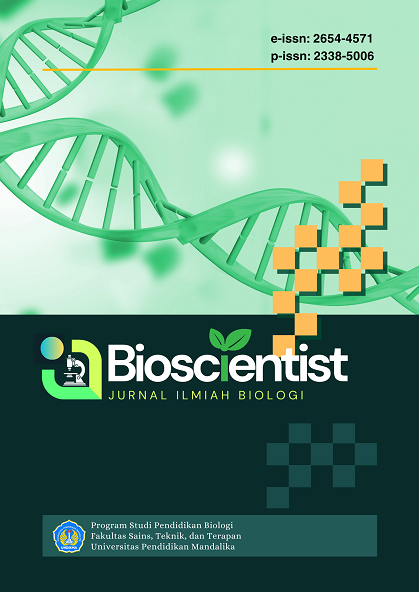
Effects of Ethidium Bromide and Sodium Dodecyl Sulfate Concentrations on the Viability of Multidrug-Resistant Bacteria Isolated from River Streams at State University of Malang
DOI:
https://doi.org/10.33394/bioscientist.v14i3.20229Keywords:
Multidrug-resistant (MDR) bacteria, plasmid curing, antibioticsAbstract
This study aimed to analyze the effect on applying various concentration combination EtBr and SDS that have been widely used in plasmid curing to the growth of multidrug-resistant bacterium encoded by MDR1 isolate originated from river stream in State University of Malang. This study is a laboratory experiment including the independent variable is the concentration combination of SDS and EtBr (treatment I: no EtBr and SDS, treatment II: 60 g/L SDS + 35 mL/L EtBr, treatment III: 50 g/L SDS + 50 mL/L EtBr, treatment IV: 40 g/L SDS + 65 mL/L EtBr), the dependent variable is the visible colonies count of the isolate MDR1, and the controlled variables are the bacterial growth media, antibiotics concentration, incubation temperature as well as incubation time. The results for the visible colonies count of isolate MDR1 after being treated with the curing agents were varied. Treatment III showed the best result in lowering the survivability of isolate MDR1 (95.55% inhibition) among the usage of EtBr and SDS, followed by treatment II (39.37% inhibition) indicating that EtBr holds stronger action in eliminating plasmid of the isolate MDR1. Treatment IV however, showed an increase of the visible colonies count of isolate MDR1 in antibiotics containing media suggesting that higher EtBr concentrations may enhance the curing of non-essential while allowing the persistence of more stable resistance determinants, leading to an apparent increase in growth, although further investtigation is mostly needed. Therefore this study contributes to develop standardize method in lowering the survivability of multidrug-resistant bacteria especially isolate MDR1 by eliminating its plasmid using curing agents.
References
Aladejana, Ogunlade, Thonda, & Obi. (2024). Plasmid Profile and Curing of Multiple Antibiotic Resistant Escherichia coli Isolated from Straw Colored Fruit Bats (Eidolon helvum). Nig. J. Pure & Appl. Sci, 37(2), 2756–4045. https://doi.org/10.48198/NJPAS/24.A10
Alegbeleye, O. O., Singleton, I., & Santana, A. S. (2018). Sources and Contamination Routes of Microbial Pathogens to Fresh Produce During Field Cultivation: A review. Food Microbial, 73(177), 177–208. https://doi.org/10.1016/j.fm.2018.01.003
Andersson, D. I., & Hughes, D. (2010). Antibiotic Resistance and Its Cost: Is it possible to reverse resistance? Nature Reviews Microbiology , 8, 260–271. https://doi.org/10.1038/nrmicro2319
Arivo, D., & Dwiningtyas, W. (2019). Pola Kepekaan Escherichia coli Penyebab Infeksi Saluran Kemih Terhadap Antibiotik. Jurnal Farmasi Malahayati, 2(1). https://doi.org/10.33024/jfm.v2i1.1540
Azour, A., Matar, G. M., & Bilen, M. (2026). Plasmid-driven Resistome Diversity in 9,700 Escherichia coli Genomes Across Phylogroups and Sequence Types. Antibiotics, 15(3), Article 287. https://doi.org/10.3390/antibiotics15030287
Buckner, Ciusa, m. l, & Piddock L.J. (2018). Strategies to Combat Antimicrobial Resistance: Anti-plasmid and Plasmid Curing. FEMS Microbiol, 42(7), 781–804. https://doi.org/10.1093/femsre/fuy031
Castañeda-Barba, S., Top, E. M., & Stalder, T. (2023). Plasmids, a Molecular Cornerstone of Antimicrobial Resistance in the One Health era. Nature Reviews Microbiology, 22, 18–32.
Davies, J., Spiegelman, G. B., & Yim, G. (2006). The World of Subinhibitory Antibiotic Concentrations. Curr Opin Microbiol, 9(5), 445–453. https://doi.org/10.1016/j.mib.2006.08.006
El-Mansi, M., Anderson, K. J., Inche, C. A., Knowles, L. K., & Platt, D. J. (2000). Isolation and Curing of the Klebsiella pneumoniae Large Indigenous Plasmid using Sodium Dodecyl Sulphate. Research in Microbiology, 151(3), 201–208. https://doi.org/10.1016/s0923-2508(00)00140-6
Gulton, H., Kuncoroadi, A., Fathiya, A., Arandri, A., Auria, F., & Hafiz, A. (2022). Perbandingan Pengaruh Agen Plasmid Curing Acriflavine dan Acridine Orange (AO) terhadap Laju Plasmid Curing dengan Kuantifikasi Fluoresensi Ekspresi Protein GFP pada Bakteri Escherichia Coli PRSET-emGFP. Buletin Poltanesa, 23(2). https://doi.org/10.51967/tanesa.v23i2.1041
Letchumanan, V., Chan, K.-G., & Lee, L.-H. (2015). An Insight of Traditional Plasmid Curing in Vibrio Species. Front Microbiol, 17(6), 735. https://doi.org/10.3389/fmicb.2015.00735
Liu, X., Wang, D., Wang, H., Feng, E., Zhu, L., & Wang, H. (2012) Curing of Plasmid pXO1 from Bacillus anthracis using Plasmid Incompatibility. PLoS One, 7(1). https://doi.org/10.1371/journal.pone.0029875
Mane, Santosh, D., & Bhosale, M. P. (2023). A Review On Prevalence Of Bacteria In Urinary Tract Infection. https://doi.org/10.30574/wjbphs.2023.14.1.0177
Millan, A. S., & MacLean, R. C. (2017). Fitness Costs of Plasmids: a Limit to Plasmid Transmission. Microbiol Spectr , 5(5), 10. https://doi.org/10.1128/microbiolspec.MTBP-0016-2017
Nurhasanah, A., Mahtuti, Y., & Husnah, A. (2024). Identifikasi Bakteri Patogen Gram Negatif pada Alat Praktikum Mikrobiologi Di Laboratorium Central Stikes Maharani Malang. Journal Borneo, 4(2), 67–80. https://doi.org/10.57174/j.born.v4i2.144
Park, H., Yang, H., Kim, S., Yun, S., & Jang, C. (2024). Comparison of Plasmid Curing Efficiency across Five Lactic Acid Bacterial Species. J Microbiol Biotechnol, 34(11), 2385–2395. https://doi.org/10.4014/jmb.2406.06003
Rasool, M. S., Hassan, M. A., Siddiqui, K., et al. (2023). Expulsion of Plasmid-mediated Antibiotic Resistance Genes in E. coli by Ethidium Bromide and Acridine Orange Treatment. Pakistan Journal of Pharmaceutical Sciences, 36(2), 341–349. https://doi.org/10.36721/PJPS.2023.36.2.SP.587-594.1
Sholekah, & D. Listyorini. (2023). Genetic Identification of Superbugs from River Streams in State University of Malang. J. Ris Biol Dan Apl, 60(41), 27–36. https://doi.org/10.26740/jrba.v5n1.p27-36
Silhavy, J., Kahne, D., & Walker, S. (2025). The Bacterial Cell Envelope. Cold Spring Harbor Laboratory. https://doi.org/10.1101/cshperspect.a00414
Soni, J., Sinha, S., & Pandey, R. (2024). Understanding Bacterial Pathogenicity: a Closer Look At the Journey of Harmful Microbes. Front. Microbiol, 1370818(15). https://doi.org/10.3389/fmicb.2024.1370818
Sonstein, S. A. & Baldwin, J. N. (1972). Loss of the Penicillinase Plasmid After Treatment of Staphylococcus aureus with Sodium Dodecyl Sulfate. J. Biotechnology, 109(1), 262-265. https://doi.org/10.1128/jb.109.1.262-265.1972
Spengler, G., Molnár, A., Schelz, Z., Amaral, L., Sharples, D., & Molnár, J. (2006). The Mechanism of Plasmid Curing in Bacteria. Curr Drug Targets, 7(7), 823-41. https://doi.org/10.2174/138945006777709601
Unok, W., & Mangawing, S. (2024). Resistensi Antibiotik Terhadap Infeksi Saluran Kemih (ISK): Literature Review. Jurnal Kolaboratif Sains, 1822–1828. https://doi.org/10.56338/jks.v7i5.5347
Vogwill, T., & MacLean, R. C. M. (2015). The Genetic Basis of the Fitness Costs of Antimicrobial Resistance: a Meta-analysis Approach. Evol Appl, 8(3), 284–295. https://doi.org/10.1111/eva.12202
Wang, H., & Joffré, E. (2025). Plasmid Copy Number as a Modulator in Bacterial Pathogenesis and Antibiotic Resistance. Npj Antimicrobials & Resistance, 3(72), 1–8. /https://doi.org/10.1038/s44259-025-00145-9
Wei. (2024). Filamentous Morphology Engineering of Bacteria by Iron Metabolism Modulation Through MagR Expression. Synth Syst Biotechnol, 9(3), 522–530. https://doi.org/10.1016/j.synbio.2024.04.009
Downloads
Published
How to Cite
Issue
Section
License
Copyright (c) 2026 Nikmatul Fitriyah, Diva Ramadina, Zahra Amadea Firdauzi Alryan, Dimas Nur Abidin, Rendra Maulana Zaki, Intan Chairun Nisa, Norman Yoshi Haryono

This work is licensed under a Creative Commons Attribution-ShareAlike 4.0 International License.